
How do you know you're actually getting a good deal?
Why spend hours hunting for a good deal when RacingTech can hunt for it instead?
The problem has two halves. Knowing what a part is worth, first: a 16 GB memory kit listed at €440 in early August means nothing until you know it usually trades around €277. Not missing the moment, second: when that same kit drops back below its usual price, it doesn't announce itself, and it doesn't last — sometimes because the offer covers only a handful of units.
The site handles the first half continuously, across two markets at once. The second is settled once and for all: the deals it detects are pushed to the Discord, with nothing left for you to watch.
Two markets. Two ways to buy. One question either way: is this the right price?
New: spotting the prices that break away
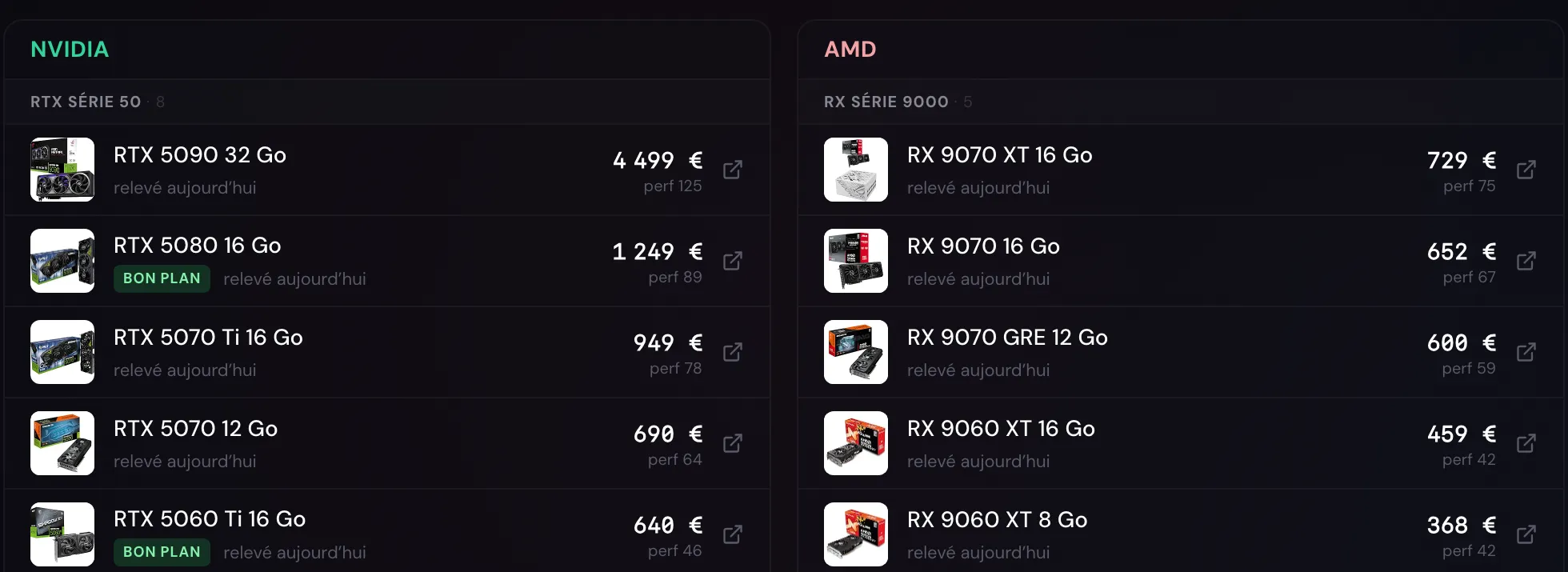
With new hardware, everyone sells the same product, and a discount means nothing until you know what it's measured against. The site keeps the lowest price per model, tracks its usual price, and only labels a price a deal when it meets two conditions: being among the lowest of the past three months, and genuinely sitting below that usual price. A flat price repainted as a promotion doesn't get through.
Four categories are tracked — graphics cards, processors, memory, SSDs — with the collection date and a performance index next to the price, plus price per gigabyte on memory. It's on New prices.
When a market runs hot, history is the only reference left
Memory is the clearest illustration right now. A single model's price swings away from its own usual level by margins that make intuition useless.
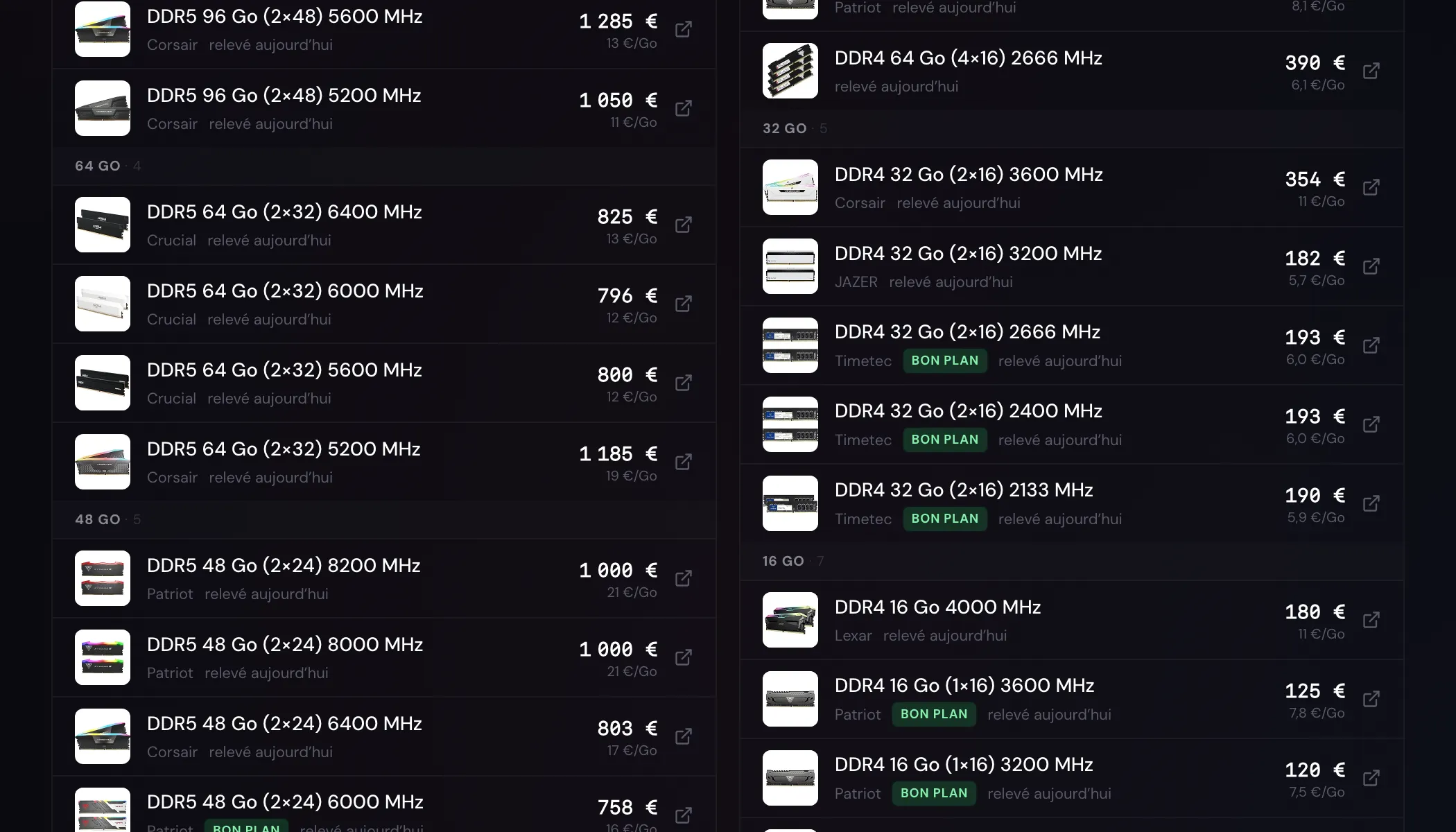
Across the 41 kits with a usable history, half sit more than 5 % away from their usual price over the past three months, ten more than 10 %, four more than 20 %. At the extremes: one kit at €2,174 against €1,320 usually, another at €96 against €133. Every figure compares a model to itself, never to another.
History is therefore the only serious reference — with one limit worth knowing: an offer sometimes covers small quantities, and then breaks away from the model's average without the market having moved at all. It's a genuine chance to buy at the right price, and it closes all the faster for it. All the more reason to be told rather than to check.
Used: a market price, not a hunch
New isn't always the better deal, and that's where the second half of the work starts. On the used market there is no official price: the going rate is worked out model by model from Leboncoin listings tracked over a rolling window, along with the market range and the threshold past which a listing becomes interesting.
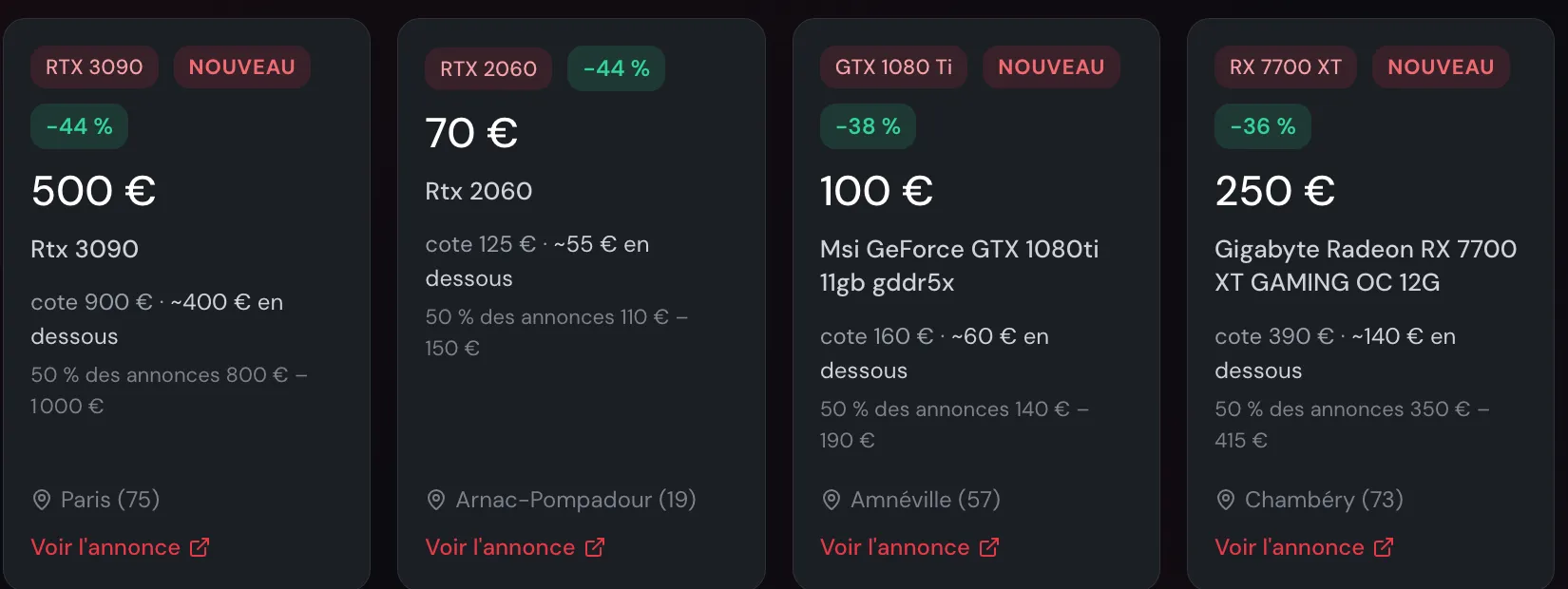
A comparison site shows a price. Here we show the gap — and the range that lets you judge whether it's genuinely unusual. Bundles and flagged listings are set aside: their price would distort the rate as much as the ranking.
« I want to buy »: what your budget actually gets
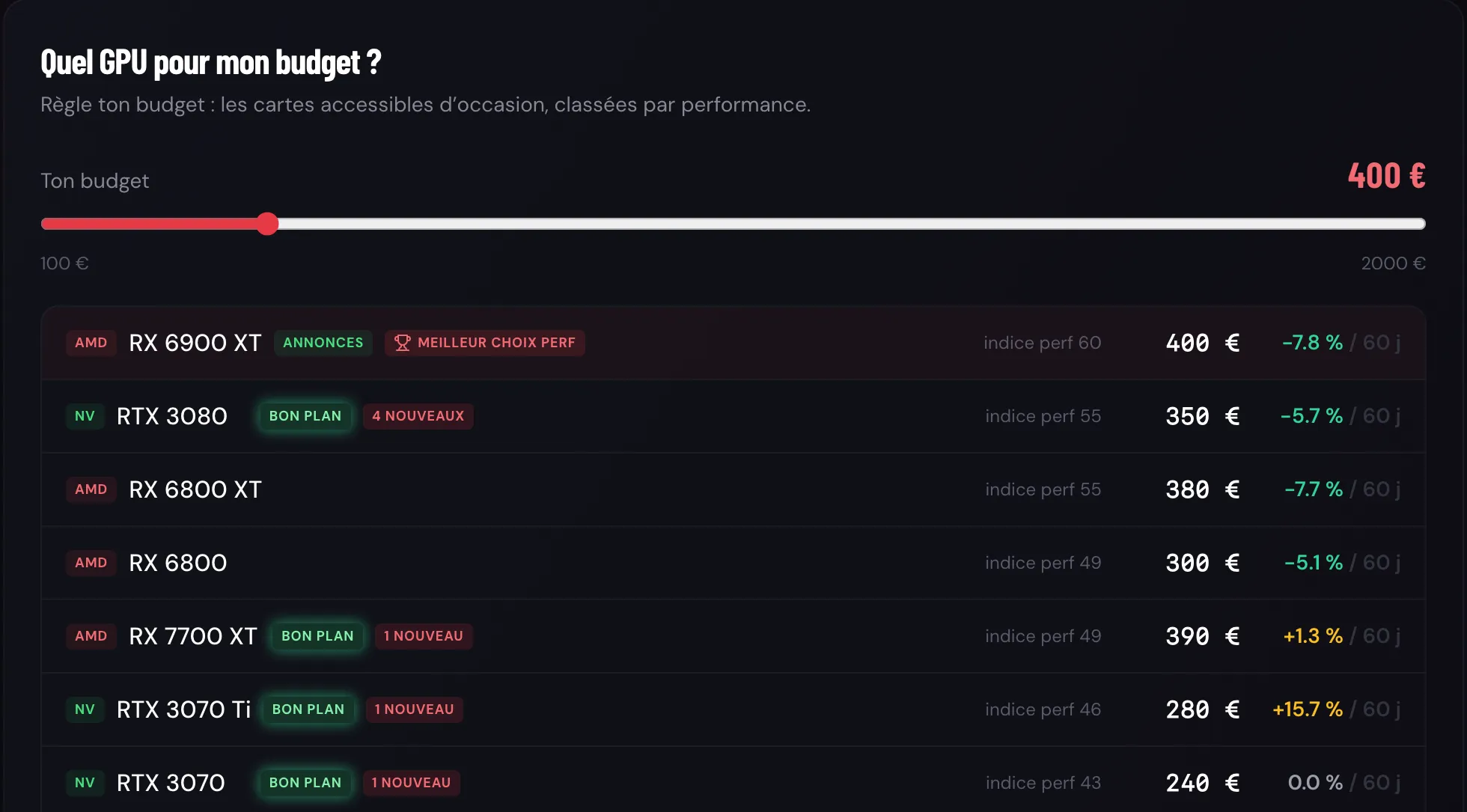
A buyer's real question isn't « what does this card cost », it's « what does my budget buy ». Models are ranked by performance — not alphabetically, and not by what pays best. Each row also shows whether the rate is drifting down or climbing back: a card that's been falling for two months isn't bought at the same moment as one on the way up. Explore it on the Price Index, with current listings on Deals.
« I want to sell »: what to ask for your card
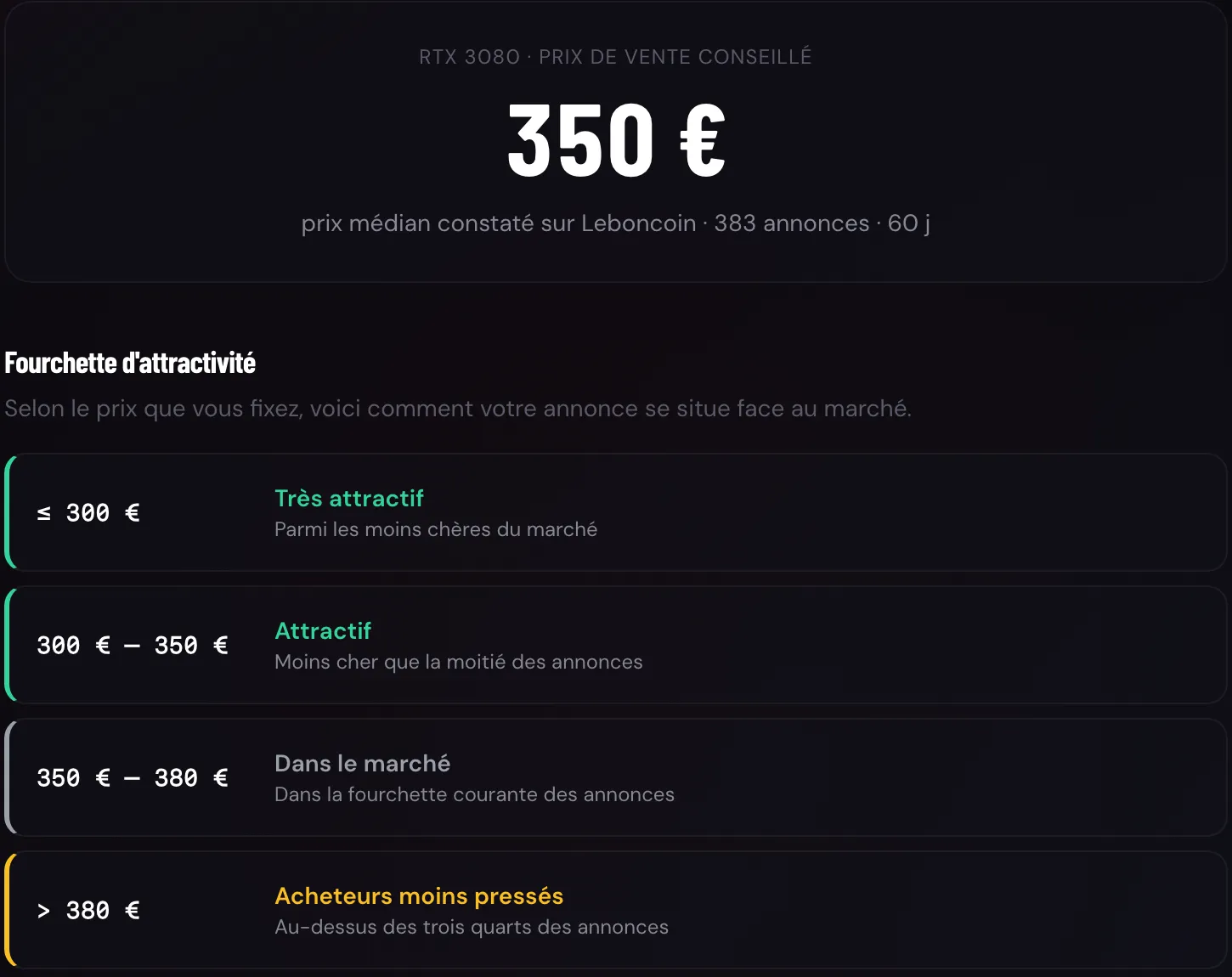
The same work serves the opposite purpose, and that's probably the most underrated use of it. Selling a card always means hesitating between too high (the listing sits there) and too low (money left behind). Pick your model and you get a suggested asking price, and what each price band implies: below a certain point the listing is among the cheapest around; above another it's aimed at buyers in no hurry. It's on the seller estimator.
And you don't even have to come back
This is the second half of the problem, and it's settled in one go. The new and used deals the site detects are posted automatically to a Discord server, several times a day. Exactly the ones on the site — the only difference is that they arrive without you going to look.
Neither exhaustive nor a guarantee. On new hardware, the price that counts is the one on the merchant's page when you order. On used, the rate is built on prices being asked in listings, not on completed sales — nobody publishes those. And a listing below the rate is still a private sale, with the usual precautions.
Amazon links are affiliate links: as an Amazon Associate, the site earns from qualifying purchases. That changes neither the price you pay nor the order things appear in — which depends only on the prices collected.