
The RacingTech story
This article is long, and it seems fair to say so upfront. If you want to understand where RacingTech comes from and the choices that shaped it, grab a coffee — there is no rush.
Two interests, the same principle
Sim racing makes it possible to take part in motorsport competition without spending a fortune on it. That is exactly what I wanted to find again in the hardware.
You can run a 24-hour race as a team, take turns through the night, chase the last tenth for months — without owning a car, without a team budget, without having to clear the financial barrier that exists in real motorsport.
That is what drew me to sim racing: the demands of competition, without the entry ticket that usually reserves it for a few.
Computer hardware, on the other hand, goes back much further.
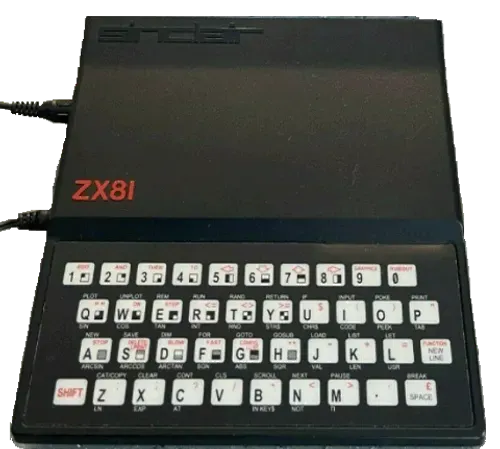
The first computer I ever saw was a ZX81, on a school trip to England. A black block the size of a book, a flat keyboard printed on a membrane, one kilobyte of memory — and, for some, a machine you assembled yourself, soldering the components before you could even use it.
I only understood it much later, but that piece of ancient hardware was already answering a question that still interests me today: how do you make something accessible when it looks out of reach?
Sinclair had an answer: design a radically cheaper machine, and accept that the user takes part in building it.
Then came an Amstrad 512, and above all the habit of opening machines to understand what was inside.
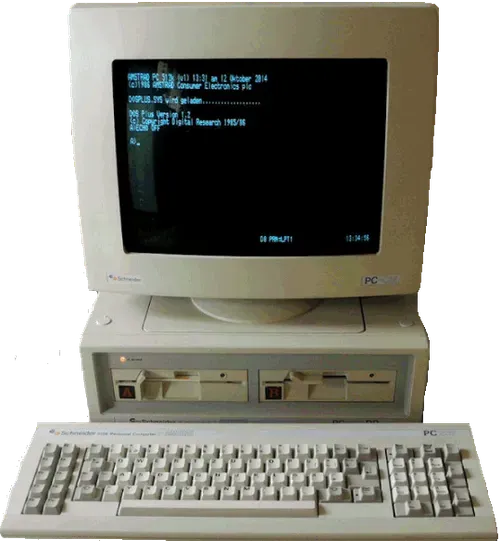
Forty years later, I am still doing much the same thing.
So bringing these two interests together felt fairly natural in the end.
Sim racing needs hardware, sometimes a lot of hardware. And once you start looking into it, you find something of a paradox: the principle that makes the competition accessible does not necessarily apply to the equipment you need to practise it.
A market without reference points
When you go looking for computer hardware, the question seems simple: how much should I pay?
In practice, the answer is far less obvious.
On the new market, prices move constantly. The same product can be offered at very different rates depending on the retailer, on promotions, or simply on the moment you happen to search. A price that looked attractive yesterday may no longer be attractive today.
And above all, seeing a product listed at €500 does not necessarily tell you whether €500 is a good price. Is it an exceptional promotion? A normal price? A product you can regularly find cheaper?
You need to be able to put that price back into context.
For second-hand, the problem is different but leads to the same difficulty.
There is no real equivalent, for computer components, of the valuation guides used for second-hand cars. No recognised reference price, no standardised condition rating, and above all no public data telling you what products actually sell for.
Classified ads show the price the seller is asking, not necessarily the price at which the transaction goes through.
So a product can sit at €400 for weeks without finding a buyer, while another, priced sensibly, can disappear within hours. And an ad that disappears has not necessarily been sold: it may have been withdrawn, or reposted elsewhere.
On top of that come mistaken listings, misidentified products, prices that are no longer up to date, and fraudulent ads.
In both cases the problem ends up being the same: there are plenty of prices around, but few reference points for knowing what they actually mean.
That absence of reference points is what interested me.
For new hardware, you need to be able to tell whether a price is genuinely competitive, and to place it within the way the market has been moving.
For second-hand, you need to arrive at a consistent value from a far less structured market.
And above all, the two markets cannot be looked at separately.
A second-hand item at €400 does not have the same value depending on whether an equivalent new product costs €450, €600 or €1,000.
The price of new gives meaning to the price of second-hand, while the second-hand market tells you whether buying new still makes sense.
That relationship between the two is one of the foundations of RacingTech.
So the aim is not simply to find the lowest price.
It is to have enough reference points to understand whether the price you are looking at is genuinely worth it, new or second-hand.
A valuation built for my own needs
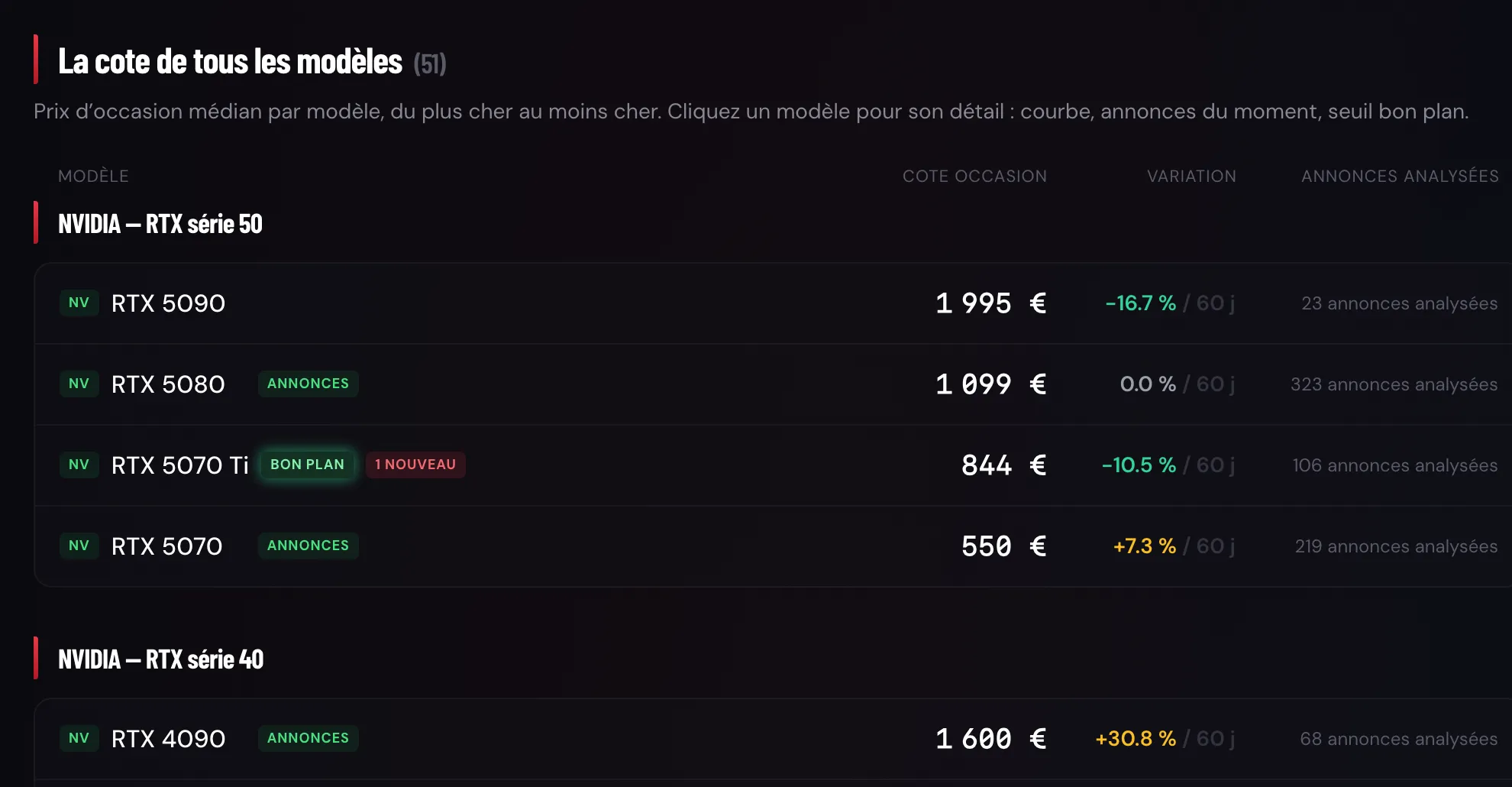
RacingTech had already been running for some time when I started working on the second-hand valuation.
At the start, the two projects had nothing to do with each other.
I simply needed, for my own purchases, to know what a second-hand computer component was really worth. Since I could not find a reference I considered reliable enough, I started building my own way of calculating it.
The idea looked simple enough: collect the available ads, compare the prices, set aside the values that stand out as abnormal, and try to reach an estimate that comes as close as possible to the real market.
But the more I worked on it, the more I realised the problem was far from that simple.
An ad is not necessarily representative of the market. A price that is too high can stay online for weeks. A fraudulent ad can distort the calculation. A genuine bargain can disappear within minutes. And the price of new hardware keeps moving as well.
So the method had to be built up gradually, to take these different elements into account.
Originally, this valuation was only meant for me.
I just wanted a tool that would help me make better decisions when buying second-hand hardware.
Then, while working on it, I wondered why I should keep that information to myself.
If this valuation could help me tell whether a graphics card was priced sensibly, it could probably be useful to someone asking exactly the same question.
That is how the second-hand valuation ended up joining RacingTech.
It was not the site's starting point, nor even something I had planned to add to it.
It is simply a feature born out of a personal need, which I eventually decided to share because it could answer a problem many buyers run into: how do you know whether the price of a second-hand item is actually fair?
And that is where the two subjects started to come together: RacingTech on one side, and this search for a reliable second-hand valuation on the other.
The rest of the work went into making that information solid enough to be used by other people.
When a good deal turns out to be a bad one
That is the point where the level of demand changed.
As long as I was building this valuation for myself, a mistake could simply lead me to a bad decision.
Once the information was published on RacingTech, the consequences were no longer the same.
Getting an ad wrong when you are buying for yourself means missing out on a good deal. The same mistake published on a site potentially sends someone towards a bad deal — or towards a scam.
So the last few weeks went into something fairly unspectacular: looking for mistakes.
Not adding features. Not multiplying charts. Not making the site more appealing.
Checking that what it displayed was true.
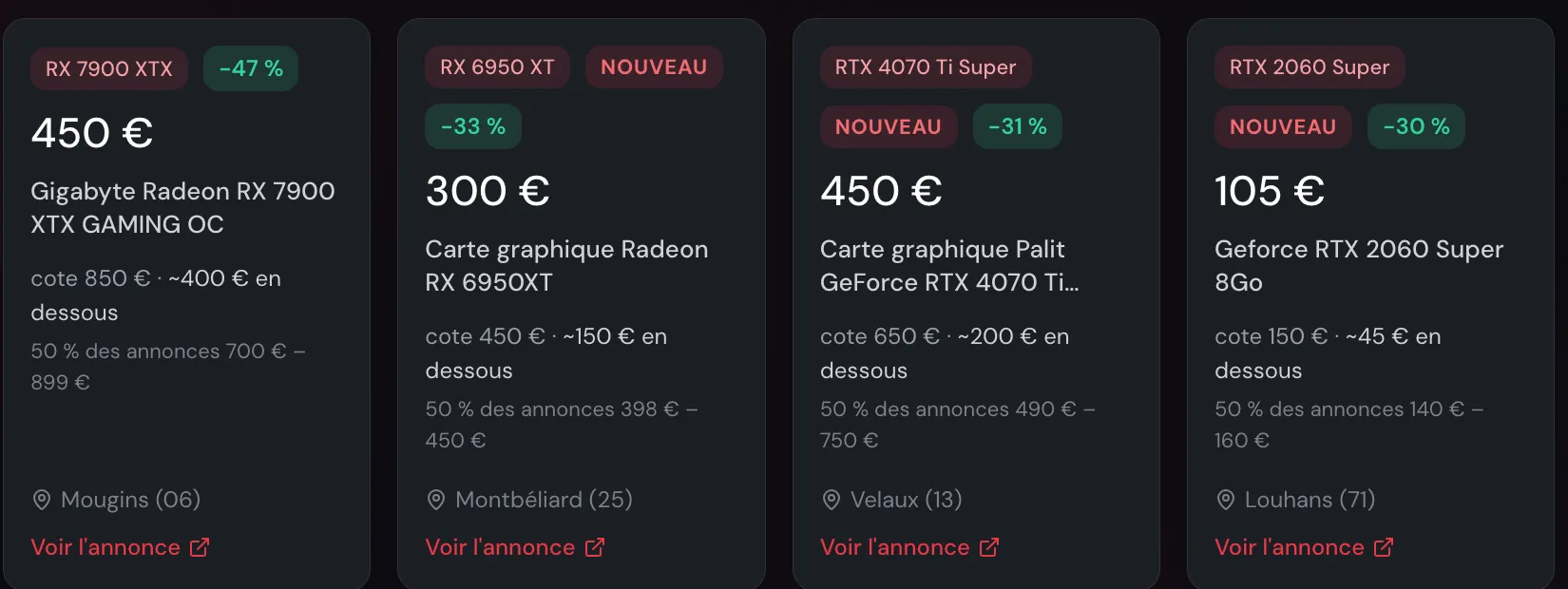
At one point, RacingTech recommended a second-hand RTX 5090 at €750, with an indicator presenting it as a good deal. The problem: a new RTX 5090 cost close to €4,500 at the time. It obviously was not a good deal. It was a fraudulent ad — and the site was the one putting it forward.
The calculation was not broken. It was working perfectly. That was exactly the problem: the system learned the market price from the ads it collected. A few fake ads had therefore been enough to teach it a false price.
Another example, on the new side: a memory module was showing at €49, while the cheapest price actually available was €123. The €49 product had been out of stock for several hours. And twelve other displayed prices had the same problem.
None of these faults were obvious when you simply looked at the site.
It looked like it was working.
And that is precisely what makes the work difficult.
It is not only about repairing what is broken. You have to look for what appears normal while being wrong.
And one point deserves honesty: this work does not eliminate scams. The filters set aside prices that make no sense, and reading a description sometimes makes it possible to spot a faulty card or a misidentified product. But a well-built scam — at the right price, with the right description — will slip through. No calculation can detect it, and pretending otherwise would be a lie. The valuation is a reference point for assessing a price, not a guarantee about the ad or the seller. The usual checks before a second-hand purchase remain essential, valuation or not: the seller's profile, their number of sales, their ratings, whether the ad holds together. RacingTech does not do that part for you — a free service maintained by one person could not. The valuation tells you whether a price deserves your attention; it is then up to you to judge whether the ad deserves your trust.
The hardest rule: accepting to show less
This work mainly takes time.
Evenings spent measuring rather than assuming. Questioning something you were sure of. Redoing a calculation because a check has just shown it was wrong.
And above all, regularly making a decision that goes against the site's immediate interest.
Keeping only the offers where delivery and purchase conditions come with enough guarantees, even when that reduces the number of offers shown.
Not promising that a price will still hold when it may change a few hours later.
Hiding an indicator when it becomes doubtful, rather than displaying an attractive bargain.
And sometimes, quite simply, showing nothing at all.
Every time, that means taking something out of the catalogue.
Yet it is probably one of the most important things I can do.
A site designed purely to generate clicks would probably do the opposite. It would show more offers, more “good deals”, more spectacular prices.
That would certainly work better for a while.
But that is not the RacingTech I want to build.
Not just finding a price, but understanding whether it is a good one
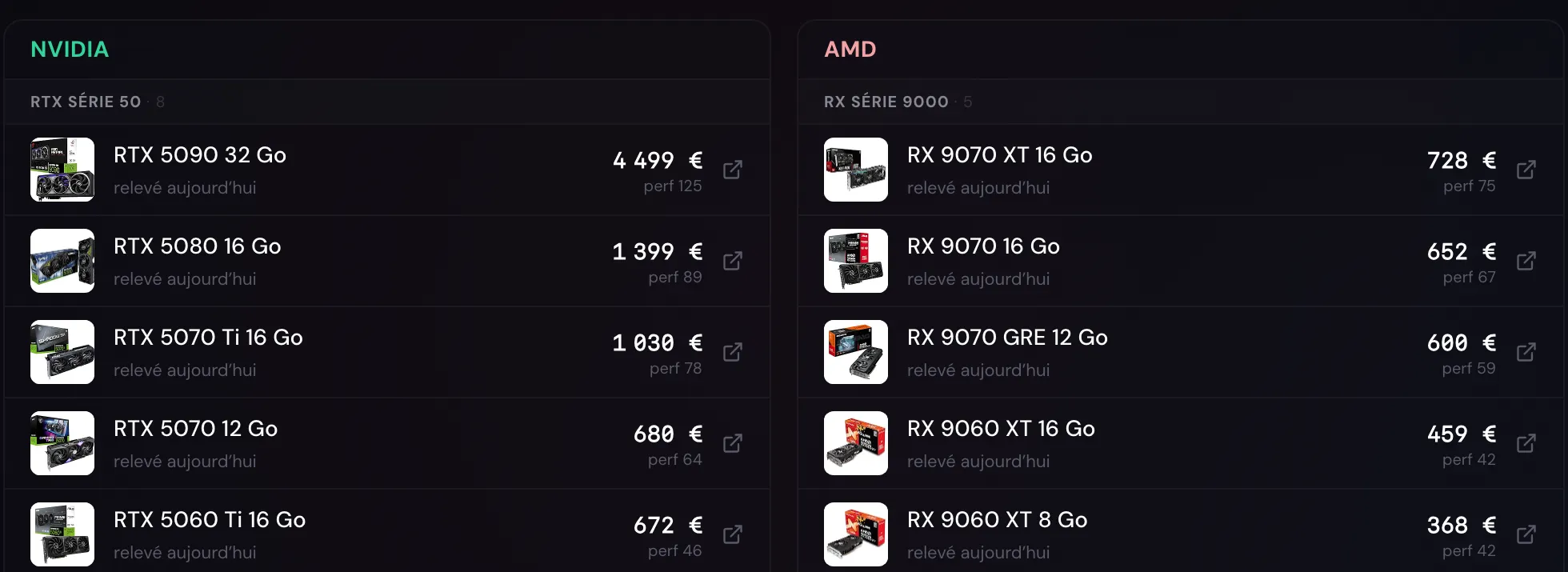
It also explains the way RacingTech is evolving.
The aim is not simply to find the lowest price.
A price on its own does not say much.
You need to know whether it genuinely matches the market, whether it is still available, whether it concerns a comparable product, whether the ad comes with enough guarantees and, above all, where it sits relative to the price of new.
That is what turns a pile of prices into information that is actually useful.
A second-hand item at €400 is not necessarily worth it because it is cheaper than another at €450.
It may be worth it if it is priced sensibly against the second-hand market, and if the gap with new genuinely justifies choosing second-hand.
Conversely, a second-hand item can look cheap while being a bad deal.
That difference is what I try to bring out with RacingTech.
And where does sim racing fit in?
If you arrived on RacingTech through the graphics card valuation, you might think the site is only about prices. That would be forgetting where it comes from.
Sim racing remains the common thread. It is what asks the question everything else tries to answer: what hardware do you actually need, and at what price? The complete builds offered on the site come from there. So do the hardware articles — manufacturer news, comparisons, buying guides, from a first wheel to the most demanding systems. Each time with the same logic as for prices: give reference points, not sell a dream.
And I practise what I write about. My own setup came together gradually, with the same trade-offs as the ones I describe in the guides — and sometimes the same hesitations, the same mistakes. I would like to show it to you before long, in photos. Not as a showcase: as a concrete example of what these choices give once assembled, with what works and what I would do differently.
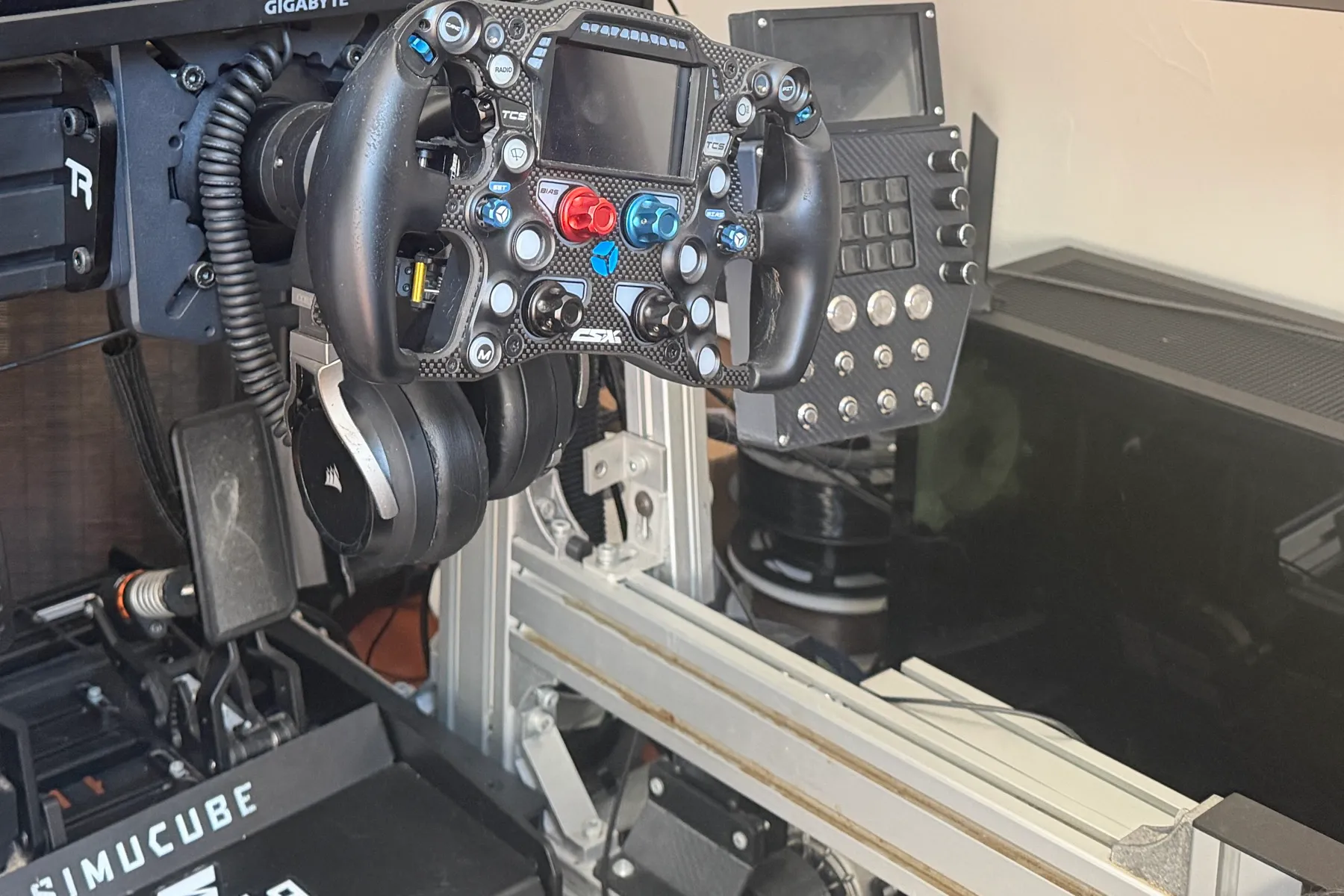
That may be the best way to sum up RacingTech: a site run by someone asking the same questions you are, and trying to answer them with a bit of method.
How RacingTech is funded
RacingTech carries no advertising, and I would rather keep it that way.
But having no advertising does not mean having no costs: servers, hosting, collecting and accessing price data, development… Running the site costs real money.
On the new market, the links to retailers are affiliate links.
If you buy a product after going through RacingTech, the retailer may pay me a commission.
The price you pay stays exactly the same.
The difference comes out of the retailer's margin, not out of your wallet.
That is what makes it possible to fund the infrastructure the site needs to run.
On second-hand, it is different.
Nobody pays for advice that keeps you from overpaying. If the RacingTech valuation helped you negotiate a price, walk away from a bad deal or set aside a doubtful ad, a coffee now and then is a simple way to support the project.
It is obviously not required, and nothing is reserved for those who do.
And one rule holds in every case: a price recorded this morning may have changed by the afternoon.
That is why the prices shown on RacingTech come with the date they were recorded. I would rather the information be dated than give the impression that a price stays valid forever.
A site that also has to accept being corrected
There is still a significant weakness in the system.
So far, every anomaly that has been fixed was fixed because I came across it myself.
A single pair of eyes cannot see everything.
Which is why users have a part to play too.
If a price looks strange to you, if a valuation seems inconsistent, if a “good deal” badge looks excessive, or if something simply does not seem to make sense, tell me.
The Discord has a section dedicated to this kind of feedback.
It is not only a way to report a bug.
It is probably the best service you can do RacingTech.
Because the point of the site is not to show you as many offers as possible.
It is to help you answer a much simpler question:
“Is this price actually worth it?”
And if RacingTech can give a reliable answer to that question, then the site will have met its goal.